

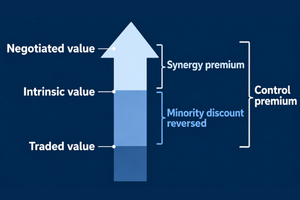
 When a buyer pays more than a company’s quoted share price, the difference is often described as a “control premium”. However, this premium can reflect two distinct sources of value: acquiring control of the business and capturing benefits from combining it with another business. Understanding the distinction is essential to applying valuation adjustments correctly.
The first angle: reversing the effect of a minority interest
Listed shares generally trade as minority interests. An individual shareholder participates in the company’s economic performance but cannot independently determine its strategy, dividend policy, capital structure or management appointments.
When a buyout is announced, the share price may rise sharply towards the offer price. Part of this increase can reflect the transition from minority ownership to control: the buyer gains the ability to influence decisions and unlock value unavailable to an individual shareholder.
In this sense, the control premium and the minority discount describe the same valuation gap from opposite directions. Where minority pricing reflects a lack of control, removing that discount moves the value towards the business’s intrinsic value on a controlling basis.
The percentages are not identical. If a business’s equity is worth $100 million on a controlling basis and $80 million on an equivalent minority basis, the minority discount is 20%, while the premium required to move from $80 million to $100 million is 25%.
The same control benefit must not be counted twice. If a valuation already reflects the business’s value on a controlling basis, an additional premium for those same rights would overstate value. Equally, reversing a minority discount and then adding a separate premium for the same control benefit duplicates the adjustment.
There is, however, an important qualification: listed shares do not invariably trade below intrinsic value, and a takeover price increase does not prove that the entire movement reverses a minority discount. Market expectations, potential operational improvements and anticipated synergies may also influence the price. Control has economic value where it enables beneficial changes; ownership alone does not justify an automatic uplift.
The second angle: paying for acquisition synergies
A separate premium may arise where the buyer and target have a natural strategic fit. Combining them could eliminate duplicated costs, improve purchasing terms, increase capacity utilisation or open profitable distribution channels.
These benefits go beyond the target’s standalone intrinsic value. They arise from the combination and may differ substantially between potential buyers. They should therefore be valued separately, using incremental cash flows after implementation costs, allowing for timing and execution risk.
For example, assume a business has a standalone controlling equity value of $100 million. A buyer identifies synergies with a net present value of $30 million. Paying $115 million would transfer $15 million of those expected benefits to the seller, while leaving $15 million for the buyer.
In a willing buyer, willing seller negotiation, the question becomes how much of the synergy value the buyer is prepared to share. Strategic urgency, competing bidders, bargaining power and confidence in delivering the benefits all affect that decision.
A defensible valuation therefore distinguishes between recovering value associated with control and paying for additional value created through combination. The premium should follow the underlying economics and the agreed sharing of benefits.