

 The traditional technology company journey used to be fairly predictable: build a product, raise venture capital, scale rapidly, go public, and let public market investors participate in the next phase of growth.
SpaceX challenges that model.
But the point of this discussion is not whether SpaceX is correctly valued, overvalued or undervalued. That is a separate debate. SpaceX is useful here because it highlights a much broader and more important question: when is the right time for a company to raise capital, and ultimately, when is the right time to IPO?
Compared with earlier generations of technology giants, SpaceX has stayed private for an unusually long time. Apple, Amazon, Microsoft, Google, Facebook and Tesla all listed at much earlier stages of their corporate lives. Public investors therefore had access to a much larger part of their value creation journey. A useful comparison is made in this article: SpaceX Needs to Get to $5 Quadrillion to Rival Mag Seven Magic.
The question is therefore not only about SpaceX. It is about the timing of IPOs.
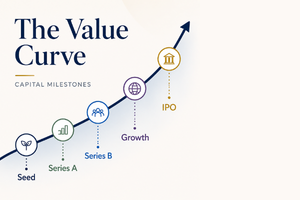
IPO timing is not a calendar decision. It is a value curve decision.
Each company has its own life cycle, capital requirements, investment cycle and addressable market. A software company with low capital expenditure, high margins and rapid scalability may be able to list earlier. A capital-intensive infrastructure, manufacturing, energy, biotech or space-related business may need a much longer private investment cycle before it is ready for public markets.
That changes the capital-raising question.
The issue is not simply: “When should the company IPO?” The better question is: “What value milestone must be achieved before the next round of capital is raised?”
Every funding round should ideally follow a value-building step. Early capital proves the concept. The next round proves traction. Later rounds prove scalability, unit economics, market dominance and the ability to generate or unlock significant cash flows. Each round should answer the question that the previous shareholders funded the company to solve, while creating a stronger investment case for the next group of shareholders.
This is where valuation planning becomes powerful.
A forward valuation curve can map the expected value of the company year by year against its strategy, capital needs and key milestones. What is the company worth after product-market fit? After regulatory approval? After first commercial revenue? After margin improvement, geographic expansion or infrastructure completion? What capital is required to reach each point, and how much dilution is acceptable at each stage?
Raise too early, and founders may give away too much equity before enough value has been proven. Raise too late, and the company may become constrained, underfunded or forced into weaker terms. Raise at the right time, and the company uses each round of capital to cross the next valuation bridge.
Liquidity also matters.
Private company shares usually carry a discount because they are harder to trade, harder to price and available to a narrower pool of investors. Public market shares can attract a liquidity premium because investors can buy and sell more easily, price discovery is more transparent, and the shareholder base is broader.
That liquidity premium can become a major value lever. If a company lists too early, it may receive the benefit of liquidity before it has fully proven the investment case. If it waits until the business has stronger traction, clearer economics and a larger addressable market story, the IPO can potentially capture both the value already created and the additional premium that comes with liquidity.
This links directly to dilution.
The goal is not merely to raise capital. The goal is to raise the right amount of capital at the highest justifiable valuation, with the least unnecessary dilution. A company that raises capital after a major value inflection point should issue fewer shares for the same amount of funding than it would have issued earlier.
That is why the IPO decision cannot be viewed in isolation. It sits within the wider capital strategy of the business: when to raise, how much to raise, from whom to raise it, what value must first be proven, and what future value is still available to the incoming investors.
The real lesson is this: an IPO is not the finish line. It is one step on the value curve.
The best time to raise capital, whether privately or through an IPO, is when the company has created enough value to justify better terms, but still has a credible and compelling next stage of value creation ahead.
That is why the valuation curve is so important as a planning tool. It allows management and shareholders to map the anticipated stages of capital raising before they happen: what must be proven, what capital will be required, what valuation may be justified, and how dilution can be managed at each stage.
The discipline is simple, but powerful: build value, prove it, raise capital at a better price, minimise dilution, and then use that capital to build the next layer of value.